Connect SalesPlay POS
Audience: Shop owner (Admin) Time: 5 minutes
Connect your SalesPlay POS account to an envoice shop and your paid receipts are filed to LHDN without retyping them. You keep selling in SalesPlay as usual. The screenshots in this guide are from a sandbox demo with example data.
What it does
- Consolidated sales (no buyer TIN, under RM10,000) are recorded for your monthly consolidated e-invoice, which envoice files at the start of the next month. Nothing is sent to LHDN per receipt.
- Business buyers get their own e-invoice. Fill in TIN number and Business registration number (BRN) on their SalesPlay customer record and attach the customer to the sale.
- Receipts over RM10,000 always file as their own e-invoice, as LHDN requires.
- Refunds (credit notes and refunds in SalesPlay) become LHDN credit notes, on every plan including Free.
- Each document keeps your SalesPlay receipt number, so you can match it to the receipt in SalesPlay.
The envoice shop needs its own LHDN credentials before anything reaches LHDN. See Start in the demo shop and go live.
1. Connect your SalesPlay account
- In SalesPlay Back Office, open Integrations, then Access Token, and generate a token. Copy it.
- In envoice, open Settings > Integrations and find the SalesPlay POS card.
- Paste the token into SalesPlay access token and click Connect SalesPlay.
- The card shows Connected with your SalesPlay business name.
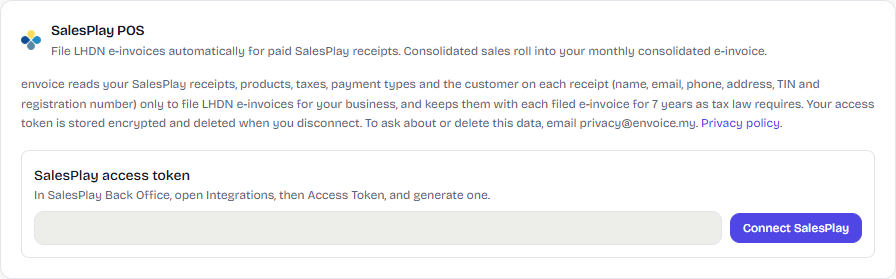
envoice is not listed in SalesPlay. You connect it from the envoice app as above.
One envoice shop connects to one SalesPlay account. If you run separate businesses with different TINs, give each its own envoice shop.
envoice picks up receipts from the 1st of the month you connect. Earlier sales can go in with CSV bulk upload.
2. Match your SalesPlay taxes
SalesPlay lets you name taxes freely, so envoice asks what each one is. On the card, under SalesPlay taxes, pick a type for every tax and click Save tax types:
- Service tax (02)
- Sales tax (01)
- Tourism tax (03)
- Not a tax (service charge): a service charge set up as a tax in SalesPlay is filed as a charge, not as tax.
A receipt that uses a tax you have not matched waits on the card. Saving the tax types puts those receipts back in the queue, and they file within a few minutes. Receipts without any tax need no mapping.
3. Choose auto-submit
The Auto-submit e-invoices switch on the card:
- On: individual e-invoices and credit notes are filed to MyInvois automatically.
- Off: they wait on the card ("receipts are waiting for you to file them") until you click File them now.
Consolidated sales are always recorded for the monthly consolidated e-invoice, whichever way the switch is set.
4. Business buyers
In SalesPlay, add or edit the business buyer as a customer and fill in TIN number and Business registration number (BRN). Attach that customer to the sale, and the receipt files as their own e-invoice with the customer's name, email, phone and address.
LHDN checks the TIN and BRN together. A buyer with a TIN but no BRN anywhere waits on the card. Add the BRN in SalesPlay, or save that customer (with the same TIN) in envoice, then click Try again now.
5. Let customers request their e-invoice
A walk-in customer who later wants an e-invoice in their own name can ask for it themselves through your customer portal. Switch on the portal under Settings > Portal, then share the portal link or print the counter poster with its QR code. The customer enters the SalesPlay receipt number, date and total, then their own details. When the receipt number and total match a receipt envoice synced, the request uses its line items.
Full portal steps: Let buyers request e-invoices (customer portal).
Refunds and voided receipts
| In SalesPlay | What envoice does |
|---|---|
| Refund of a business buyer's receipt | Files a credit note against its e-invoice, once that e-invoice is validated |
| Refund of a consolidated sale, same month | Takes the refund off the consolidated sale before the monthly consolidated e-invoice is filed |
| Refund of a consolidated sale already in a consolidated e-invoice | Files a credit note against the consolidated e-invoice |
| Refund of a receipt that is still waiting (for example for a tax mapping) | Waits, and files as soon as the original receipt is filed |
| Voided consolidated sale, same month | Removes it from the monthly consolidated e-invoice |
| Voided receipt that already has its own e-invoice | Shows on the card: cancel the e-invoice in envoice within 72 hours, or issue a credit note |
Receipts that need attention
When a receipt cannot be filed, the card lists it by its SalesPlay receipt number with the reason, for example an unmatched tax, a missing BRN or your plan limit. Fix the cause, then click Try again now.
If LHDN rejects a document after it was filed, the receipt is listed too, with Open document. Open it to see LHDN's reason. envoice does not refile it by itself.
Instant sync
When you connect, envoice asks SalesPlay to tell it about new receipts and credit notes, so they arrive within seconds. envoice also checks SalesPlay every few minutes and catches anything missed. If the card shows Turn on instant sync, click it.
Disconnect
Click Disconnect on the card and confirm. envoice removes its SalesPlay webhooks and deletes your access token. Paid receipts are no longer filed until you reconnect. Documents already filed stay in envoice and at LHDN.